NCP is a grouping of regional organizations across European that helps local researchers, and businesses access EU funding, such as Horizon Europe and the Digital Europe Programme.
These regional contact points are vitally important to advancing technology and sustainability. In particular, they give the support, the information and the networking to ensure that regional expertise can be brought to international partners for collaborative projects.
Being based in the Walloon region, the branch of NCP asked Bruno Damien from e peas his view on participating in European tenders for technology, and in particular the success of the EFFECTOR project that is focusing on the problems the EU faces in terms of battery waste and how energy harvesting can solve this issue.

We’ve translated the text and reproduced it below with permission. And we recommend that innovative technology firms in the region not already working with NCP do so.
E-peas, the Louvain-la-Neuve gem that’s reaping the rewards… and European successes
Based in Louvain-la-Neuve, e-peas has established itself as a leading Walloon company in sustainable microelectronics. Having won several European projects, it embodies the face of local innovation with global impact.
A fabless company with global ambitions
Founded in 2014 by Geoffrey Gosset and Julien De Vos, both engineers from UCLouvain, e peas has carved out its niche within the highly competitive world of microelectronics thanks to a unique specialization: ambient energy harvesting.
“We design electronic components that allow connected objects to power themselves without disposable batteries, by harnessing energy from light, radio frequency, heat, or vibrations,” explains Bruno Damien, marketing director in charge of partnerships at e-peas.
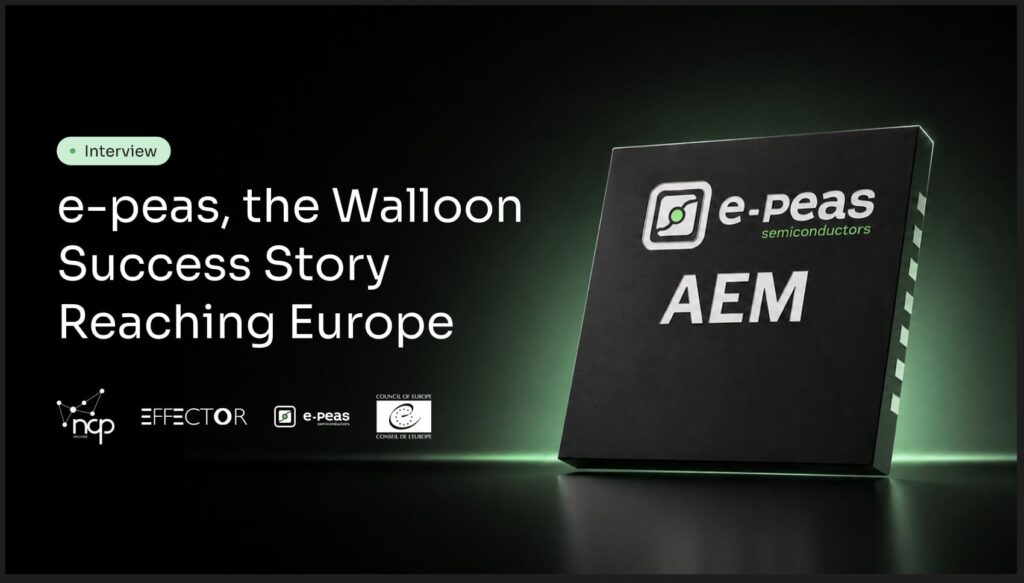
The company doesn’t own a factory (it’s fabless), but designs, develops, and markets its own integrated circuits, these “semiconductor components encapsulated in black epoxy resin,” measuring just a few square millimeters, that orchestrate the operation of countless electronic devices, from computer keyboards to industrial sensors.
Based in the heart of the Louvain-la-Neuve technology ecosystem, the company currently employs around forty people and has a commercial presence in Europe, the United States, and Asia. It recently obtained ISO 9001 and ISO 14001 certifications, confirming its commitment to quality and sustainability.
Eliminating disposable batteries: an ecological battle
e-peas’ ambition goes far beyond technical performance: “Our mission is to eliminate disposable batteries. Every year, in France alone, one billion alkaline batteries and 250 million lithium batteries are put on the market,” explains Bruno Damien.
“Half of them end up in landfills without being sorted, with serious environmental consequences. We offer a clean, reliable, and sustainable alternative.”
A Walloon SME in the big leagues of Europe
With e-peas now held up as a blueprint for Walloon innovation, it is also thanks to its growing success in European programs.
After participating in several collaborative research projects, the company recently won new funding as part of the EFFECTOR project, supported by the European Commission under Horizon Europe.
“EFFECTOR is not our first success,” explains Bruno Damien. “We had already participated in projects before. And with EFFECTOR, we continue to enrich our ecosystem: it is a consortium led by the CNRS in Pau, focused on low-power and low-light photovoltaics and its indoor applications, bringing together international equipment manufacturers, which is exactly our core business.”
The project, which began in January 2025, aims to develop a new generation of non-toxic organic photovoltaic cells capable of powering sensors and autonomous indoor devices. “The CNRS approached us for our expertise in energy management and ultra-low power consumption. Our integrated circuits are used to interface and regulate the conversion of this ambient energy.”
Europe as an ecosystem accelerator
Beyond funding, e-peas emphasizes the strategic value of European programs for technology SMEs: “When we participate in a European project, we enter a virtuous cycle, because we are integrated into the databases of European projects, contacted by other players, and as a result we become visible to join new projects,” explains Bruno Damien.
His advice to Walloon companies? “First, you need to be visible: this includes very basic steps like creating a PIC code, registering on the EU Funding & Tenders portal, and ideally getting support from organizations like NCP Wallonia.
“Then, you need to be selective: don’t respond to every call for tenders, but only to projects aligned with your company’s strategy and that of Europe.”
A success story made in Wallonia
e-peas perfectly illustrates the ability of Walloon SMEs to integrate into European value chains. Its technological expertise, which has been developed in university laboratories, has found its place alongside major industrial groups in international consortia.
“We remain a commercial company,” emphasizes Bruno Damien. “Our projects must lead to concrete applications within two or three years. This industrial realism is our strength.”
And what’s next? “We’re already working on the next phase of EFFECTOR, which is still confidential. The idea is to maintain this momentum and continue to strengthen our European ecosystem. Wallonia is brimming with talent; we need to capitalize on this wealth.”
With its ambient energy harvesting circuit technology, its constantly expanding portfolio of over 15 products, its global partnerships and its successes in Horizon Europe, e peas embodies a new generation of Walloon technology companies: innovative, sustainable and connected to the European ecosystem with an international reach.
“Our ambition is to continue on this path, to strengthen our network and to transform our European successes into industrial opportunities,” concludes Bruno Damien.