
To set up an energy harvesting system, you need a harvester, a storage element, and an AEM. The AEM is the central component of the system. It extracts the maximum power provided by the harvester and stores it in the storage element, so that this energy can be used later — and in some cases, it can even be used to directly power the application.
Home page AEM All products AEM10920
AEM10920
High-efficiency photovoltaic MPPT boost PMIC with DCDC output
e-peas’ AEM10920 is a high-efficiency energy harvesting PMIC that maximizes power extraction from PV cells. It supports MPPT ratio and timing configuration ensuring adaptability to various PV cells.
With ultra-low power cold start, the AEM10920 can efficiently operate from minimal available energy. Its configurable protection levels, integrated 5V storage charger, regulated DCDC output and shipping mode ensure compatibility and makes it an ideal solution for long-term deployments.
Optimized for efficiency and reliability, the AEM00920 is a perfect choice for low power energy harvesting applications.

Product Information
Products
Harvester input
- Maximum Power Point Tracking (MPPT)
- High-Efficient Boost Converter
- 120 mV to 4.35 V
- Up to 135 mA
- Open Circuit Voltage Up to 4.35 V
- Cold Start from 1.5 µW / 275 mV
Storage element
- 2.4 V to 4.35 V
- Configurable Protection Levels
Load output
- High-Efficient Buck Converter
- 2.2 V to 2.8 V
- Up to 100 mA
Extra features
- 5 V Charger Input
- Boost Converter Timing Configuration
- Shipping Mode
Package
- QFN24 4x4mm
Features and benefits
Ultra-Efficient Boost Converter
- Efficiency above 90 %
- Harvests from 120 mV after cold start
- Up to 135 mA current extracted from the harvester
Maximum Power Point Tracking (MPPT)
- Configurable MPPT ratio and timings to match various PV cells
Ultra-Low Power Cold Start
- Cold start from 1.5 µW / 275 mV
Configurable Storage Element Protection Levels
- Configurable overdischarge, charge ready and overcharge protections to support a wide range of rechargeable storage element types
Regulated Output for Application Circuit
- Buck regulator with efficiency above 90 %
- Selectable output voltage among 2.2 V, 2.5 V and 2.8 V
- Output current up to 100 mA
5 V Charger
- Extra charging input for 5 V power supplies
- Configurable current limit up to 135 mA
- Provides a fast charging alternative when no source is available for a long time
Shipping Mode
- Storage element charge and discharge disabling during shipment
Boost Converter Timing Configuration
- Configurable boost timing multiplication factor for compatibility with various inductors
Low BOM
- Reduced external component requirements
Block Diagram

Evaluation boards
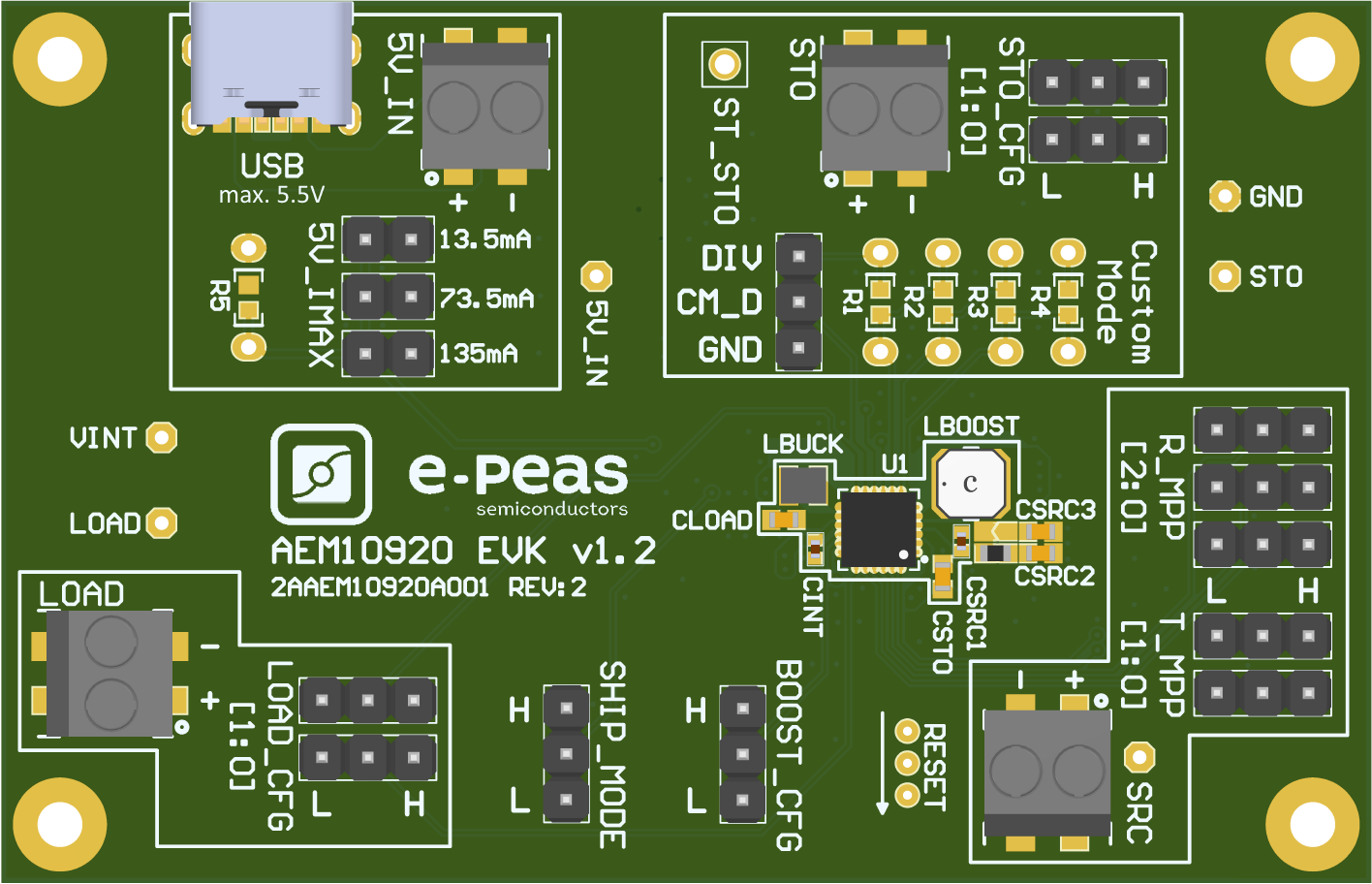
The AEM10920 Evaluation Board (76 mm x 49 mm) offers a complete solution for testing the features and performances of the AEM10920 energy harvesting PMIC in QFN-24 package. It includes the necessary passive components for optimal operation and a set of jumpers for easy configuration.
Designed for flexibility, the board allows full configuration and provides:
- Energy harvester input, with its configuration settings.
- Connection for the storage element, with configurable protection levels and custom mode configuration.
- Load output with output voltage configuration.
- Optional 5V charging input by USB-C or screw terminal, with maximum current configuration.
- Shipping mode configuration.
- Boost converter timings configuration.
- Status signal pin access.
For detailed setup and advanced features, refer to the AEM10920 datasheet and EVK documentation.

The AEM10920 Mini Evaluation Board (18 mm x 16 mm) offers a compact alternative to the standard evaluation board and supports all the AEM10920 configurations and functionalities while offering easier integration into development setups.
- All connections via solder pads ensure easy access.
- Configurable via solder bridges and resistors, supporting full flexibility in setup.
- Optimized for quick prototyping.
For detailed setup and advanced features, refer to the AEM10920 datasheet and mini EVK documentation.
How it works
Basic Functionality
Energy Harvesting Sources
Load Regulation
Storage Element Protection
DC-DC VS LDO
Support
Need advice on choosing the right solution for your appliances?
We are here to assist you every step of the way. At e-peas, your satisfaction is our priority!
Our products are suitable for a wide range of applications
Smart Home & Buildings
Smart Locks
Leak detectors
CO2 sensor
Humidity sensors
Security systems
Occupancy sensors
Temperature sensors
Lighting Controllers
Consumer Electronics
Remote controls
Gaming controllers
Keyboard
Mice
Portable speakers
Headphones
E-readers
Smart scales
Webcams
Industrial IoT
Access control
Asset tracking
Metering
Smart factory
Predictive maintenance
Smart HVAC
Remote Control
Webcams
Smart Retail
Electronic shelf labels
Commercial lighting
Advertising anchors
Direction finding
Wearables
Luxury & Smart watches
Smart hospitals
Portable medical devices
Fitness bands
Wellness trackers
They tried it. They signed up for life for their devices.
Our customers share their experiences.

Toshiya Yamamoto
Vice-President Business Development at Nichicon
The long history of partnership between Nichicon and e-peas proves that both companies can mutually enhance their presence in strategic projects with key customers and at global business events, and that both companies can find great synergy.
Nichicon has developed an energy harvesting evaluation board and provided it to customers. e-peas’ excellent low-power PMIC can maximize battery performance.
Read more 
Niklas Forsgren
FAE Director at Epishine
Collaborating with e-peas has been both rewarding and impactful. Their broad range of configurations, and technical expertise have been instrumental in advancing energy harvesting technologies.
By working together, we’re not just addressing market needs but actively shaping its future. I’m excited to deepen this collaboration as we continue to build a strong ecosystem for sustainable innovation.
Read more 
Hao Yin
CEO of TEGnology
TEGnology and e-peas have had several years’ collaborations in the field of Thermal Energy Harvesting, and there is no reason not to believe the collaboration will continue.
Combining TEGnology’s superior thermal energy harvesters with e-peas’ high efficiency PMICS is enriching each other field presence and customer value proposition. We count on each other’s expertise and reputation, when we propose solutions to the market. By standing together, we can close the deals with better offers. This turns out to be an exciting and fruitful way of collaborating.
Read more 
Giampaolo Marino
Senior Vice President of Strategy and Business Development at Energous
“e-peas PMICs are an integral part of a wireless power network, enabling RF harvesting for battery-free IoT devices such as sensors and tags. The combination of Energous' PowerBridge transmitter systems and IoT devices powered by e-peas' technology will revolutionize the way organizations power and interact with their connected technologies.”
Read more Contact us
Ready to test?
Your next technological breakthrough starts here.
You may also be interested
AEM00940/1
High-efficiency photovoltaic constant voltage boost PMIC with two LDO outputs

AEM13921
High-efficiency dual-source constant voltage and MPPT boost PMIC with DCDC output
AEM00900/1
High-efficiency photovoltaic constant voltage boost battery charger
AEM15820
High-efficiency wide input power range with hybrid boost PMIC and DCDC output
Not so fast!
Discover our wide range of products that are revolutionizing the autonomy of intelligent devices and the sectors we address.
Applications
Our cutting-edge solutions are driving change across sectors – smart home, consumer electronics, industrial IoT and beyond.
Energy harvesting PMIC (AEMs)
Enable your devices to harvest more with our ambient energy managers.
New solution: microcontroller (MCU)
Enable your devices to consume less with our microcontroller EDMS105N.
Need some advice?
Find the ideal solution with our experts.
Any questions?
WHAT ARE THE DIFFERENT ELEMENTS REQUIRED TO BUILD AN ENERGY HARVESTING SYSTEM?
WHAT ARE THE POWER RANGES IN AN INDOOR AND OUTDOOR ENVIRONMENT?
The power generated depends on the type of harvester, its size, and the environment.
For example, in the case of Photovoltaic energy harvesting, the output power will depend on the size of the photovoltaic cell, the light intensity, and the PV cell technology used.
- Indoor Photovoltaic energy harvesting generates power in the range of hundreds of microwatts. (These values may vary depending on the size of the cell.)
- Outdoor Photovoltaic energy harvesting generates power that can reach tens of milliwatts. (These values may vary depending on the size of the cell.)
Other types of harvesters include thermal, RF, and vibration harvesters.
- Thermal energy harvesting (TEG) relies on temperature differences and typically generate power in the range of a few microwatts to several milliwatts, depending on the thermal gradient and the efficiency of the thermoelectric materials.
- RF (Radio Frequency) harvesting capture energy from ambient radio waves, such as those emitted by Wi-Fi, GSM, or TV signals. The power levels are usually very low, often in the microwatt range, and highly dependent on the distance from the emitter and the frequency band.
- Vibration or piezoelectric harvesters convert mechanical vibrations into electricity. The harvested power can vary from a few microwatts up to several milliwatts, depending on the frequency and amplitude of the vibrations as well as the mechanical structure of the harvester.
Each harvester type has its strengths and limitations, and the choice depends on the available energy in the environment and the application’s power requirements.
CAN I HARVEST ENERGY FROM MY WIFI?
Wi-Fi transmissions are limited by regulations to a maximum of +20 dBm at the transmitter. In most cases, this power level is insufficient for effective energy harvesting.
Significant losses occur as RF energy propagates through the air and along the RF path on the PCB. These losses are frequency-dependent and tend to be lower at lower frequencies.
To have full control over the emitted power, antenna characteristics, and transmission duty cycle, we recommend using a dedicated RF transmitter.
CAN THE APPLICATION BE POWERED DIRECTLY BY AN AEM?
Some AEMs have a regulated output to power an application circuit. Depending on the AEMs, different converter architectures are available. Some are designed with an LDO, with a BUCK, or with a BUCK_BOOST architecture.
Sometimes, the application circuit can also be supplied directly from the storage element or thanks to an external DCDC connected on the storage element and driven by the status of the AEM. In this case, a regulated output is not mandatory.
HOW CAN WE CONFIGURE AN AEM?
AEMs can be configured using the GPIO pins by connecting them to a high state or to GND. However, some AEMs include I²C communication for the configuration and monitoring. This allows overriding the configurations set by the configuration pins and allows accessing to all the AEMs configurations, enabling wider range of settings and allowing live system monitoring