Today’s supply chains are highly dependent on real-time tracking and the use of IoT asset trackers by transportation and logistics sectors is set to increase rapidly over the coming years. Indeed, the market for real-time location systems (RTLS) in these sectors alone is forecast to almost triple between 2025 and 2034, reaching USD 22.5 billion.
Most of these asset trackers are currently powered by batteries, and this creates an issue for the companies implementing them.
Batteries hold a finite amount of energy. They die. And when they do, their replacement is costly. Beyond the price of the battery itself, replacing them requires staff to both find the affected unit and replace the battery. Over time, the OpEx of staffing this can add up to significantly more than the original CapEx of the IoT tracking device itself.
The use of batteries also introduces the potential of system-wide vulnerabilities. When a tag’s battery unexpectedly fails, it can cause the tracked item to disappear from the network, with data no longer collected. The result of this happening can be disruptions and bottlenecks in the supply chain that can undo all the efficiency gains that were the reason for implementing the IoT-based system in the first place.
In this blog, we’ll examine how a switch from battery-based systems to Ambient-IoT devices that harvest energy from the surrounding environment can lead to significant operational expense savings and prevent production line downtime.
Asset Tracker System Design
A teardown of any IoT asset tracker will typically show two core function blocks (location and communication) coupled to an energy-efficient MCU and a power source. This power source is typically a battery, but energy harvesters, coupled with an energy store and a PMIC, are increasingly being used (see the OpEx benefits below).
The location and communication technologies implemented will vary according to their operational environment. GPS will primarily be used for location in long-distance shipping, and techniques such as Wi-Fi scanning (or BLE beacons, BLE Angle of Arrival (AoA) systems such as Quuppa, or Wirepas mesh) in logistics warehouse settings.
Bluetooth LE (for indoor-only assets), LTE-M (for global coverage from outdoor assets) and LoRaWAN are the major communication standards. LoRaWAN is particularly notable as it gives seamless indoor and outdoor coverage, and can use private, public, community, and satellite networks.
Depending on the specific device, we might also see a range of secondary sensors. In an asset tracker, these might include an accelerometer to detect movement and initiate wake-up sequences, allowing it to be in deep-sleep mode at all other times. Other sensors might be for temperature or humidity, to ensure a package has been stored suitably.
In the case of energy harvesting, the PMIC can report how much energy is being harvested and stored, for example through average power monitoring, so that the MCU can adapt the behavior of the device accordingly.
CapEx and OpEx of an Asset Tracking Device
In this section, we’ll compare the CapEx and OpEx of a “typical” battery- and PV cell-powered IoT asset tracker.
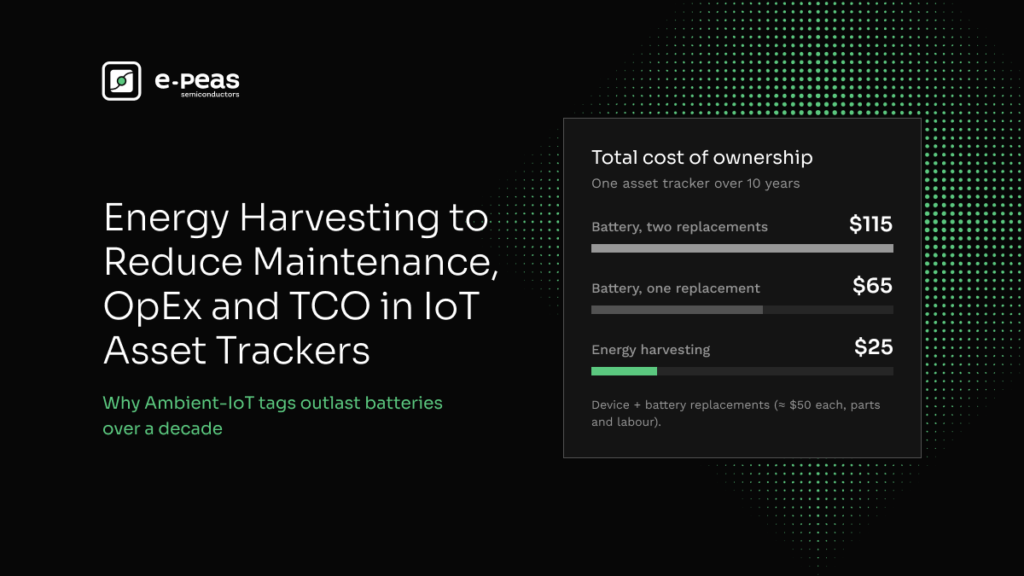
Starting with CapEx, a “typical” battery-powered device can be expected to retail somewhere in the region of $15 (US). A comparable tag that is based on the latest energy harvesting technology would be expected to cost around $25. The reason for this increase is two-fold: part of it is the higher BOM cost, and part is a premium for improved reliability, a lower environmental impact and lower operational costs.
Moving on to OpEx, and again starting with battery-powered asset trackers. Such devices would be expected to be operational for approximately a decade. However, because stated battery lives will tend to be an overestimate based on ideal- rather than real-world conditions, batteries will fail during the product’s operational lifetime. For a large proportion of devices, more than one change will be needed.
The average cost of replacement, once both the battery and the man-hours to undertake it are factored in, will be in the region of $50. This brings the total cost of ownership (TCO) of a battery-powered device to $65 with one replacement, or $115 with two.
Because it is continually recharged, the Ambient-IoT tag requires no battery replacement, meaning its TCO remains at $25 over the decade.
Of course, the above figure only factors batteries into the TCO. As we touched on earlier, it’s not as simple as that and other costs of battery failures can be supply-chain disruptions, bottlenecks and inventory losses, which can increase the OpEx and TCO of battery-powered devices many more times over.
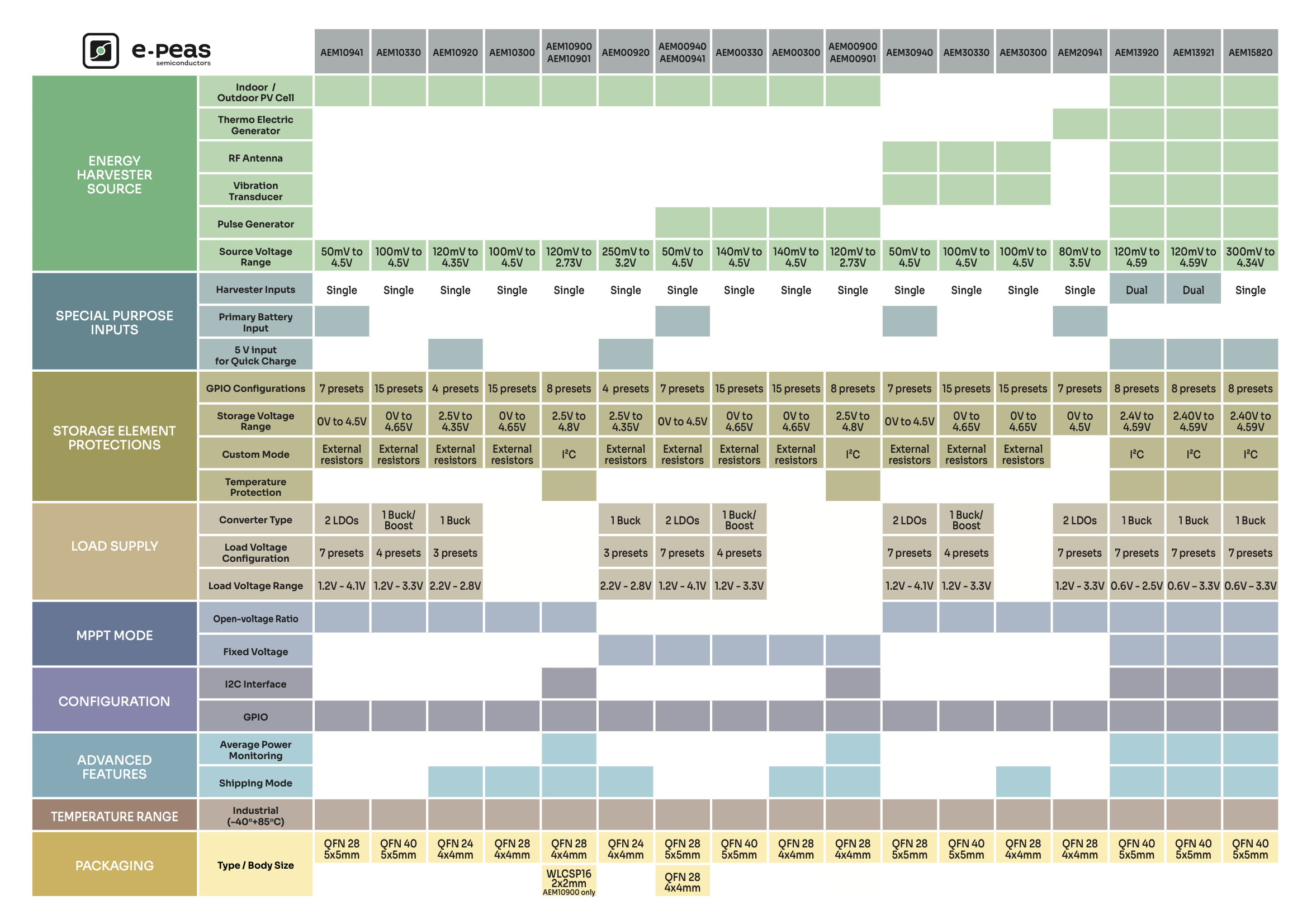
Figure 1: The e-peas PMIC selector guide can help optimize the PMIC selection based on the system’s harvester and energy store
Implementing an Energy-Harvesting Asset Tracker
To replace the battery, three core components are required: the harvester, an energy storage element, and a power management IC.
The energy harvester: For logistics and transport applications, the most readily available source is light: either daylight for outdoor tracking tags, or artificial light for tags used in indoor warehouse environments.
Several photovoltaic (PV) technologies can be used, including amorphous silicon, crystalline silicon, organic (OPV), dye-sensitized and perovskite cells. Each offers its own balance of indoor and outdoor performance, form factor, flexibility and cost, and the right choice depends on the lighting conditions and the mechanical design of the tag. PMICs from e-peas offer configurable maximum power point tracking (MPPT) to adapt to a wide range of PV cells, leaving designers free to select the technology that best fits their product.
The energy store: Both the type and capacity of the energy store should also be a key consideration. Asset trackers can deploy either a rechargeable chemical-based battery, a supercapacitor, or a lithium-ion capacitor (LiC). These differ in energy density, self-discharge and longevity. The intended operating environment should also be considered: supercapacitors generally tolerate low temperatures better than batteries, while high temperatures accelerate ageing and self-discharge in all storage types.
The PMIC: A PMIC manages the power flow between the harvester and the energy store, and delivers a stable, regulated supply to the IoT system.
This should be chosen based on the type of harvester and the type of energy store used. Selecting the right one will help maximize the lifespan of the supercapacitor or battery by preventing it from overcharging and overdischarging. The e-peas PMIC selector guide (Figure 1) helps match a device to the harvester and energy store.
In situations where a tag may spend long periods in the dark and its energy store could become fully depleted (for example, on a warehouse shelf), the cold start capability of the PMIC should also be a key consideration. In short, the PMIC should be able to undertake a cold start based on the realistic light levels that it is expected to encounter.
For example, with its ultra-low cold-start capability, the AEM10330 is well suited to indoor asset trackers, while the hybrid AEM15820 suits indoor and outdoor applications.
Power Budget Analysis
Before selecting any of these components, it is vital that a power budget analysis is undertaken to ensure the energy available from harvesting can meet the power needs of the application.
The device needs to be capable of autonomously running throughout a 24-hour period and therefore has to harvest more energy on average than it consumes. The starting point for such an analysis will be to calculate the power consumption of the device, the amount of light available to the device and the number of hours per day this is available (including in winter if powered by natural light).
From this, it’s relatively simple to calculate the area required for any given PV cell technology and to determine the required energy store capacity to ensure it can still run during the night, or at a required rate when on a dark warehouse shelf.
As we touched on above, techniques can also be used to lower the power consumption of the device. For example, integrating an accelerometer to initiate wakeup and location transmission only when the package is moved.

Figure 2: inVirtus EosFlex Beacon, a battery-free Ambient-IoT asset tracker based on an e-peas AEM10330 with energy storage and PV cell
A Real-World Example
e-peas has worked with multiple companies operating in this sector to enable the creation of Ambient-IoT asset tracking devices, including inVirtus, Jeng IoT, Minew and MOKO SMART. These companies develop logistics and transportation tracking systems and have already introduced energy-harvesting devices.
For example, the inVirtus EosFlex Beacon (pictured above) is a thin, flexible, battery-free BLE tag with Angle of Arrival (AoA) positioning, based on the AEM10330, a energy store, and a PV cell. It can operate for up to three weeks in complete darkness. This tag has been adopted by Thales to monitor part movements and work orders, with each part transported across and between facilities in a tagged box.
This not only enables continual location tracking, but according to data from inVirtus, switching to this asset-tracker based system has saved Thales an average of 30 minutes per part movement, and up to two hours when locating items of equipment that are shared by two or more divisions. The system is also being used to help ensure priority part movements are undertaken first, with an LED activated on the relevant box blinking to alert the relevant people to the urgency.