Semiconductor technology follows many trends, one of which is the consistent reduction in minimum features dimensions and active power for a given function from one generation to the next. One key parameter that is often used to compare and discuss electronic equipment’s and their evolution is the power they use.

Whereas Energy is often ignored it is also of high interest for this analysis. Possibly the reason for this ignorance is because we have an heritage of endless energy availability and abundance. But is it really the case any longer?
The relationship between power and energy is simple Energy = Power x duration (the device is “powered”). In other words, Power is Energy spent (or generated) per second.
The relatively small amounts of “power” that can be scavenged using existing energy harvesting technology is often abused as an argument to minimize capability of energy harvesting based systems. And it is often done even in publications that enlighten energy harvesting technics. In the end, “energy harvesting” is not “power harvesting”.
Similarly, when a developer is selecting a Battery to supply a Smart phone, he does not speak about power but about “energy stored in the battery”. The same applies to energy harvesting: we have to shift temporarily the paradigm to Energy-based thinking and compare implementations one each other. By implementation we mean how to supply an application, either with Energy harvesting or with non-rechargeable battery (so called Primary batteries) or rechargeable batteries.
Once we include time in our budget computation the situation looks totally different than comparing power before: energy sources like ligt, vibration, thermal variation, vibration etc etc are more than enough to enable a wide range of IoT applications, with endless capability. “Endless” means “attractive from an Operation Expense standpoint”. This introduces OPEX.
While jumping into this economical comparison as some may argue that the OPEX attractiveness is offset by an extra Capital Expense (CAPEX). In this paper we will discover that is not really true. Let’s review why.
Sensor nodes in IoT are the ideal use-case for energy harvesting.
The technology of energy harvesting has improved : Solar panels are more efficient and well understood booth in indoor and outdoor lighting conditions, the amount of energy generated through thermal and motion scavenging is increasing.
Perhaps more importantly, the Power Management ICs (e-peas PMICs) will ensure that most of the energy that is harvested can be supplied to the application and or the storage element: this is why e-peas banner make the focus on “harvest more and consume less”.
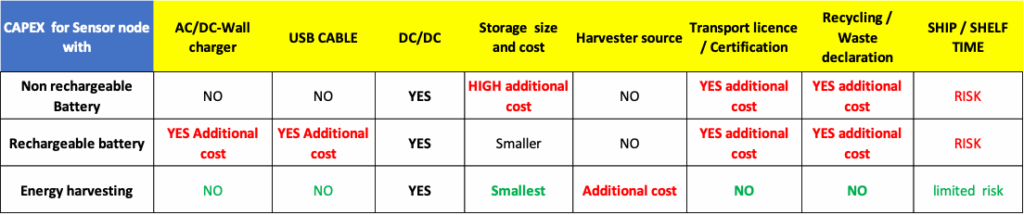
The CAPEX and OPEX comparison for 3 types of energy source across various point of view: Energy Harvesting, Non rechargeable battery, Rechargeable battery.
Some may believe that energy harvesting is an expensive design choice. We are demonstrating it is not both from CAPEX and OPEX stand point.
CAPEX:
A pure battery-based architectures require some dedicated circuitry and costly hardware. Either they are rechargeable hence they need charging and protection circuitry and the necessary AC/DC + AC connection and protection + USB cable plus + DC DC converters, or they are not rechargeable they need a DC DC buck boost converter. However, the non-rechargeable storage element is often over-sized so that it encompasses the whole variety of mission profiles of the object: as such we find Dual AA, Triple AAA, CR2477 for a simple tiny device. Specific manual mounting arrangement and assembly/ manufacturing cost are more expensive. They need space, volume, as well as some form of clip/ screws to mount and retain / isolate energy source for shipment and at the very least a dedicated terminal and leads plus dust-proof seeling that often loses its capability after the first open close action . They also have a specific weight.
What is the difference with Energy harvesting?
Obviously, the AC/DC functions are not present in Energy harvesting solutions.
The DC DC conversion is smaller and worst case the storage element protection are on par with Batterie base solutions; Usually the Storage element is much smaller in energy harvesting because energy harvesting brings complementary energy source to the system all over the life time of the product.
We summarize the better CAPEX value proposition of Energy harvesting based solutions here:
OPEX:
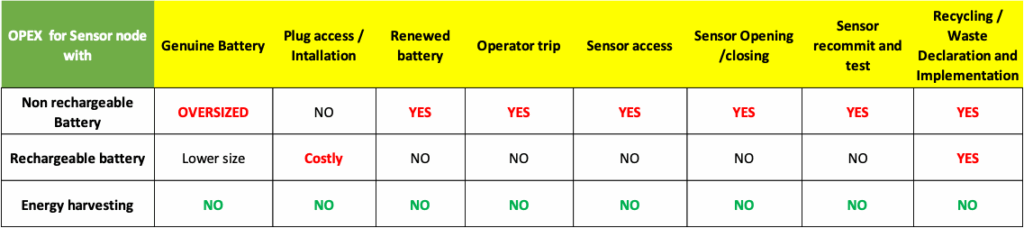
Here we explore what will be expended by the end-user during the lifetime of the product to maintain its Quality of Service, while it is used in the field. We cover the same 3 situations as for CAPEX analysis.
When non rechargeable, the replacement of a single CR2032 coin cell cost much more than the raw volume price. It is often seen that they are priced 10 to 20 time more than what the OEM will pay in high volume. (A minimum 1 or 2 USD each and every time). Getting rid of this cost is definitely an end-user benefit.
That is just for a one-on-one battery replacement.
Consumer or end users usually get this cost as a burden that is diluted over other things. However, it is interesting to see how big the battery box where those spare ones are stored is growing in size over time. Whoever has changed the battery of its equipment found old batteries that are already quasi empty or self-discharged while they were stored in a box waiting patiently for a maintenance.
This process is getting critical for B2B applications as man-power intervention comes to the picture, either for the system integrator or for the Business user, or even both: it is required to carefully reach the physical place of the object, unmount it, open, replace the batteries, store the used one for recycling , close, mount/ fix again and check operation is OK. This take time, it is costly and inconvenient , time is money.
What about designing a sensor node that is bringing competitive advantages to the OEM, the developer, the designer?
An object that can be simply fired and forgotten because it is maintenance-free, battery-free, smaller in size, lighter, proving un-interrupted services, being ship-time and shelf-time agnostic, easy to carry and transport, embracing eco-friendly best practice, reducing pollution and waste mess, innovative and user friendly?
What about the benefits for system integrators?
System integrator can not only promote the value of improved performance and share the gains within the value chain, including:
- Increased QoS
- Maintenance-free
- Increased Available Time of operation
- Being Greener / Sustainable products
- Reduced OPEX
- Shelf / Ship time agnostic
We summarize the lower OPEX value proposition of Energy harvesting based solutions here:
Conclusion:
Whereas is it commonly agreed that Energy harvesting bring an Operation Expenditure advantage over whatever battery based solution, the fact that initial hardware cost (CAPEX) is also less expensive compared to traditional battery based solution is demonstrated in table 1 of this article.
With a bit of common sense and a holistic view, one can agree that energy harvesting solutions bring real positive value to the whole ecosystem, not only on initial hardware cost but also on operating expense of multiple of IoT type of application.
About e-peas:
e-peas develops and markets disruptive ultra-low power semiconductor technology. It enables industrial and IoT wireless product designers to significantly extend battery life and reduce the high cost of battery replacement—without compromising reliability.
With 15 years of research and patented IP, the company’s products increase harvested energy and drastically cut power consumption in wireless sensor nodes.
Headquartered in Mont-Saint-Guibert, Belgium, e-peas also has offices in Switzerland and the USA. The company offers a full portfolio of energy harvesting power management ICs, microcontrollers, and sensor solutions.
Contact e-peas:
Email: sales@e-peas.com
Bd Baudouin 1er N°19, 1348 Ottignies-Louvain-la-Neuve
Belgium