Wearable electronic devices are set for growth
The development and employment of wearable electronic devices have rapidly increased in recent years. Their global market size has been valued at USD 32.63 billion in 2019 and is projected to further increase in the next years.
The interest in wearable electronic devices is due to the considerably wide number of possible applications, ranging from biomedical to robotics and from consumer to industrial. Wearable electronics have to fulfil some basic requirements, such as biocompatibility, light weight, and, in particular, low-energy consumption.
The smart wearables market consists of sales of smart wearable devices and related services for tracking vital pieces of data related to the health and fitness of the human body. Smart wearables are any form of an electronic device intended to be worn on the human body.
The main devices of smart wearables are smartwatches, smart glasses, fitness and wellness devices, smart clothing and others. Smart clothing is essentially an electronic device that communicates with other connected devices (such as smartphones) as well as the wearer’s body.

The increasing demand for wireless sports and fitness devices is projected to drive the smart wearables market. There is a rapid growth in the use of smart devices such as smartwatches among cyclists, runners, gym-goers, swimmers, and athletes to track the calories burnt, hourly activity, stationary time, and activity time.

Thanks to the continuous development of electronic components that require less and less power, the possibility to harvest electrical energy from the environment is becoming both of interest and potentially viable. The effectiveness of the energy harvesting techniques has been proven by the development of battery-less autonomous sensor modules.
Wearables and battery challenges
The ever-increasing power and shrinking form factors of electronic devices enable a rapid expansion in the variety and sophistication of use cases for wearables. Wearables can come in the form of implantable devices, fitness trackers, smart jewellery, watches, shoes, and clothing with emerging applications, such as:
- Health monitoring with movement and fall detection, emergency calling, and vitals reporting for example, body temperature, oxygen levels, and cardiac signs)
- Sleep monitoring and therapy
- Meal/calorie tracking
- Hearing enhancement
- Social distancing, and contract tracing and tracking
Battery life is critical in wearables. Low power operation is essential with battery sizes restricted by physical space limitations.

Energy harvesting as a green and cost-efficient solution
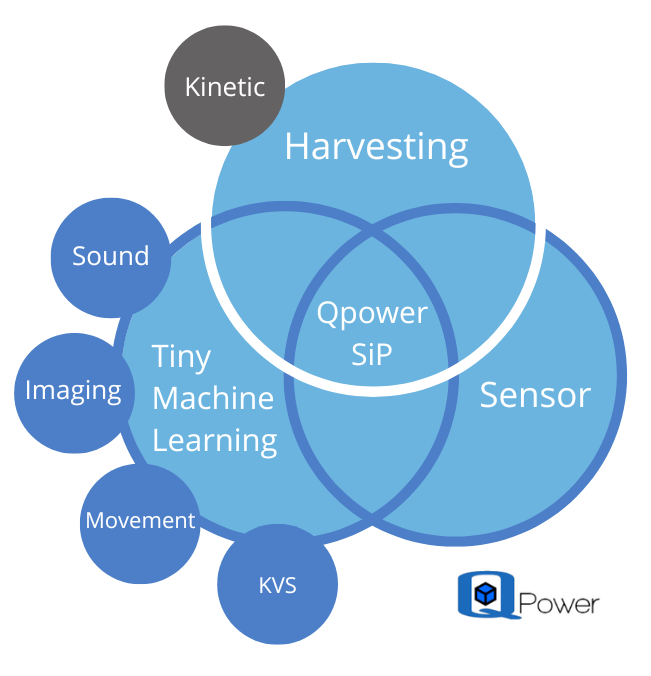
e-peas and QPower are the companies that lead the [r]evolution in energy management in IoT devices. e-peas develops Power Management ICs that enable energy harvesting from different energy sources that surround electronic devices. QPower is specialised in smart modules with sensors, TinyML, Wireless communication and kinetic energy harvesting.
In collaboration with e-peas and other strategic partners, QPower developed a state of art wearable platform with chip-like packaging which harvests energy from people’s movement.

The module is so small that it can easily be attached to a body. TinyML senses the body and environment. The platform uses off the shelf components such as e-peas Power Management ICs. Their patented IP about kinetic energy harvesting has the following characteristics and performance:
- Frequency independent
- Orientation-independent (Isotropic)
- Scalable
- Efficient
- Compact
@continue 2Hz; Current 1inch prototype results 50-10 mW; expected results for 20x20x5 mm – 30-50 mW; expected results for 2.5×2.5×2.5 mm – 3-5 mW.
Haven’t joined us on LinkedIn yet? Join us here!